

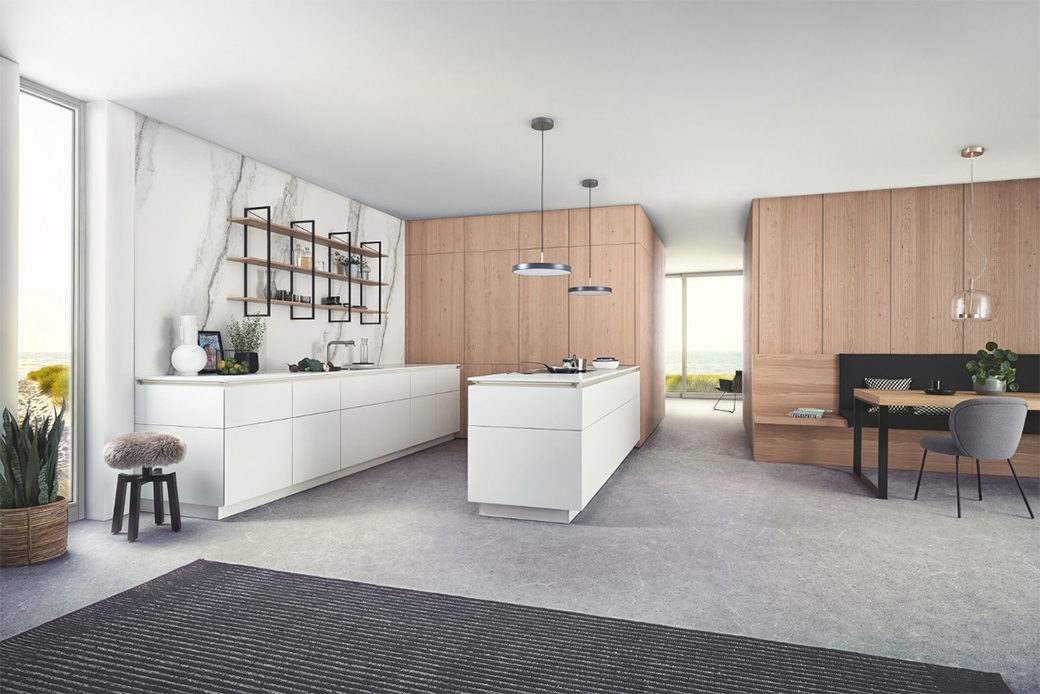
Every Dublin homeowner weighing up a house move eventually asks the same question: would it be simpler, and cheaper, to invest in luxury kitchens instead? The answer, more often than most people expect, is yes. When stamp duty, agent fees, legal costs and a larger mortgage are added together, moving house can cost several times more than a full kitchen renovation – without necessarily delivering a better quality of life.
This guide breaks down the real, comparative costs of both routes for a typical Dublin home, so you can decide with confidence whether to relocate or reinvest in the space you already own. For a broader look at how this decision plays out beyond the kitchen alone, see our related guide, Renovate or Relocate? Why a Luxury Kitchen Can Transform Your Home.
Key Takeaways
- A mid-range kitchen renovation in a Dublin semi-detached home typically costs €20,000 – €40,000.
- Moving to a similar, upgraded house nearby often adds €60,000 – €150,000 once purchase price and moving costs are included.
- Renovation means four to eight weeks of disruption but avoids stamp duty, legal fees, a bigger mortgage and leaving your area or school.
- Moving makes sense when you need extra bedrooms, more garden space or a different location; renovating suits homes that already fit but need a better kitchen.
Should You Move House or Renovate Your Kitchen? (Quick Comparison)
Take a three-bed semi in Dublin 12: upgrading the kitchen might cost €28,000 – €35,000, fully fitted. Selling up and buying a similar house nearby with a finished kitchen typically adds €80,000 – €120,000 to the purchase price, plus a further 5 – 8% in transaction costs. Renovation suits owners happy with their home’s size and location but frustrated by a dated kitchen; moving suits families needing more bedrooms, a better garden, or a different school catchment that no renovation can fix.
What a Mid-Range Kitchen Renovation Actually Costs
A mid-range renovation typically includes new units, quality appliances, quartz or premium laminate worktops, new flooring and tiling, and updated electrics, with only minor layout changes – well below the full bespoke scope of luxury kitchens. In Dublin apartments or small terraces, expect €18,000–€28,000; in a 12–18m² semi-detached kitchen, €22,000–€40,000, depending on finish. Dublin labour rates, typically 15–20% above the national average, push costs above generic national estimates. Fitted units and installation usually account for €6,000–€15,000, while building work and labour – electrics, plumbing, plastering, tiling and fitting – often make up 45–55% of the total. Extras such as underfloor heating can turn a €22,000 plan into one closer to €30,000.
The Real Cost of Moving House Instead
Consider a worked example: selling a €550,000 three-bed semi in Dublin 14 to buy a €650,000 house with a finished kitchen. Estate agent fees run 1–2%, solicitor fees €2,000–€3,000, and a survey €500–€900, on top of mortgage arrangement fees.
- Stamp duty at 1% adds roughly €6,500 on that move – equal to 20–30% of a mid-range kitchen renovation budget.
- Professional removals typically cost €1,000–€3,000, plus storage and connection fees where needed.
- A higher purchase price means higher long-term mortgage repayments and potentially higher property tax, even once the kitchen is done.
Comparing the Numbers
Spending €30,000–€35,000 on a mid-range kitchen compares with an extra €100,000 on purchase price plus €15,000–€25,000 in fees and moving costs for a comparable house with a better kitchen. A well-planned renovation typically returns a substantial share of its cost in added home value, particularly in sought-after Dublin suburbs, while moving locks in a larger mortgage for decades. In cash terms, the true cost of moving for many families can equal a full renovation of the entire ground floor – not just the kitchen.
Non-Financial Factors: Lifestyle, Stress and Disruption
Renovating typically means four to eight weeks of building work, dust and a temporary loss of your kitchen. Moving brings its own disruption – viewings, house hunting, mortgage approval and settling into a new area. Staying put keeps children in the same school and preserves local networks, with the option to phase further work over time; moving offers immediate access to more space where that’s genuinely the priority.
When Renovation Is the Smarter Choice
Renovation tends to win when a home is structurally sound, the bedroom count already works, and the frustration centres purely on a cold, dark or cramped kitchen. In many 1960s and 1970s Dublin semis, removing a non-load-bearing wall between kitchen and dining room and installing one of our luxury kitchens can transform the ground floor for €30,000–€45,000 – often pushing a home into its next value band without transaction costs. Owners planning to stay five to ten years typically see the strongest return from this route. This is exactly the territory our sister guide explores in more depth – what to look out for before committing to a move .
When Moving House Makes More Sense
Moving becomes the more rational choice when a home is fundamentally too small – lacking a bedroom, office or parking that cannot be achieved without a costly extension – or when the location no longer suits, whether that’s commute, schools, or wanting a house rather than an apartment. A full home renovation – rewiring, replumbing, insulation and a kitchen – can run to €1,500–€2,500 per m², and for homes with structural issues or a very poor BER rating, that budget may be better used as equity towards a more efficient property.
Financial Planning Tips
- Confirm your borrowing capacity or savings limit first, then set a realistic figure for a renovation or the full “moving pot”.
- Allow at least 10–15% contingency on a renovation budget for older-house surprises.
- Get at least two renovation quotes before assuming a move is cheaper, and check Property Price Register sales rather than asking prices.
Whichever route you choose, working with an experienced kitchen design team makes a measurable difference to cost control and outcome. As an official Leicht dealership, McNally Living brings German engineering and bespoke design to Dublin renovations, helping homeowners get true, lasting value from premium kitchens built around how they actually live – explored further in How a High-End Kitchen Redefines Your Living Space.
FAQ: Renovate Your Kitchen or Move House in Dublin?
Is a kitchen renovation a good investment before selling?
A well-executed mid-range renovation can help a property sell faster and often recoups a significant share of its cost in a strong Dublin market, though overspending on ultra-high-end finishes in a modest area may not be fully reflected in the sale price.
How long should I stay after a renovation to make it “worth it”?
Owners planning to stay at least five to ten years typically see the best value, enjoying daily use of the upgraded space while the market gradually absorbs its added worth.
Can I live in my house during a full kitchen renovation?
Most Dublin homeowners stay in their home throughout, using a temporary cooking area and phased scheduling, though some prefer short-term rental during the dustiest stage.
Do I need planning permission to renovate my kitchen?
Standard internal renovations and unit replacements usually don’t require planning permission, but extensions or significant structural changes may, so it’s worth confirming with an architect or local authority first.